
Call (615) 209-7643 Get my free estimate
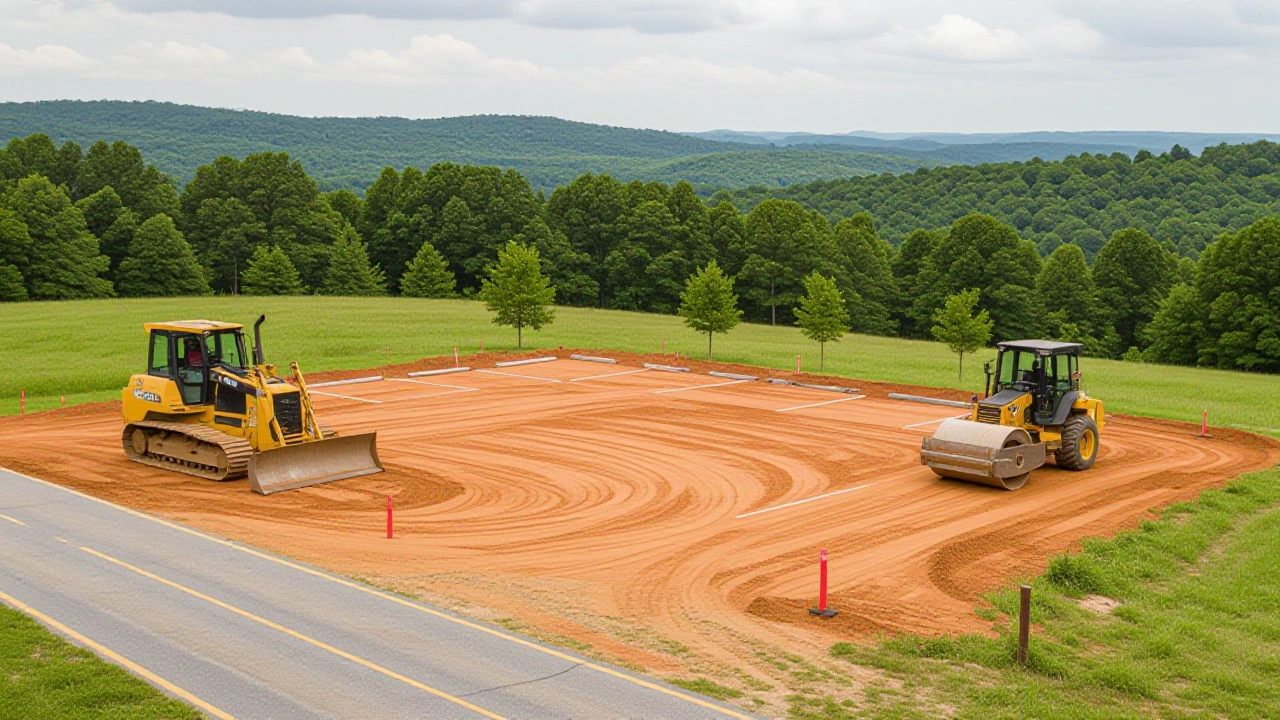
Cleared commercial site with a graded building pad, curb lines staked and a gravel construction entrance

11 · Commercial & Residential Site Preparation

Site preparation in Nashville, from first clearing to final grade

Site preparation takes a lot “from initial clearing through final grading,” so the foundation crew walks onto a level, compacted pad and the utility crew finds the ground where the plan says it will be.

Call (615) 209-7643 or send the estimate form

The order the work goes in

The order matters more than any single step. Silt fence that goes up after the clearing is too late for the first storm. A utility trench cut after final grade means grading twice. Topsoil left in place under the pad becomes a soft layer under the slab.

  • Construction entrance and silt fence set
  • Clearing and grubbing inside the limits
  • Topsoil stripped and stockpiled
  • Cut and fill to rough grade
  • Building pad compacted to elevation
  • Utility trenches dug and backfilled
  • Final grading, topsoil back, seed and straw

The building pad

The pad is the part the foundation crew cares about. It has to sit at the elevation on the plan, reach past the footprint far enough for forms and equipment, and be compacted in layers so it carries the slab or footings without settling. On many sites it’s tested, or proof-rolled with a loaded truck to find soft ground, before the next trade takes over.

Soft spots found in the pad get dug out and replaced with stone or good fill, never covered up. Fixing one now costs a fraction of what a cracked slab costs later, and it’s the last chance to do it cheaply.

A house lot and a commercial site are different jobs

On a house lot the plan is usually a plot plan with a footprint, a driveway and a finished floor elevation, and the grading around the house has to shed water away from it. A commercial site comes with civil drawings: surveyed stakes, parking lot subgrade, curb lines, storm pipes and often a detention pond, with tolerances to match. The steps are the same. The paperwork and the scale aren’t.

On either one the stakes come first. Elevations are checked against them while the cut and fill go on, so the pad lands where the drawings put it and not just near it.

Outside Metro: Williamson County’s land disturbance permit

In unincorporated Williamson County, the County Engineer issues a Land Disturbance Permit, filed online. Its policy calls for one on activities over an acre, on smaller sites that are part of a larger common plan, and on any project adding 10,000 square feet or more of impervious surface. Driveways, parking and roofs all count toward that impervious number, which is why a commercial pad on a modest lot can still need the permit.

What this covers

  • Initial clearing
  • Building pad
  • Final grading

Talk it through

(615) 209-7643

Free, no-obligation estimates. You get the schedule before the work starts.

Get my free estimate

Answers

Questions about site preparation

What does site preparation include before building a house?

Site preparation for a house covers clearing the building area, setting erosion control, stripping and stockpiling topsoil, cutting and filling to rough grade, building a compacted pad at the planned elevation, digging utility trenches, and final grading once the foundation is in. The goal is a lot where the foundation crew can start the day they arrive.

How much does it cost to prepare a lot for a house?

It depends mostly on the lot. A flat, open lot needs little more than a pad and erosion control, while a wooded, sloping one needs clearing, stump removal, cut and fill, and maybe imported fill or rock work. Driveway length, utility runs and truck access add to it. Each lot is priced on its own.

What is a building pad?

A building pad is the area of compacted soil, built to a set elevation, that a house or commercial building’s foundation sits on. It extends past the footprint to leave room for forms and equipment, and it is built up in compacted layers so it supports the slab or footings without settling.

Why is the topsoil stripped off a building site?

Topsoil is full of roots and organic matter that decompose and compress, so it makes a poor base for a slab, a footing or a driveway. It is stripped from the building area, stockpiled on the lot, and spread back over the yard during final grading, where it does the job it is good at: growing grass.

What is the difference between site preparation and site clearing?

Site clearing is one step: removing the brush, trees and debris from the project area. Site preparation is the whole sequence that follows, through erosion control, topsoil stripping, cut and fill, the building pad, utility trenches and final grading. Clearing gets the ground open; preparation makes it ready to build on.

Why does a building site need a gravel construction entrance?

To keep mud off the road. Trucks leaving a muddy site carry soil onto the street, where it washes into storm drains. Tennessee’s construction stormwater permit requires a stabilized construction access on covered sites for that reason. A pad of large stone at the exit knocks most of the mud off the tires before they reach pavement.

Free estimate

Get an estimate for site preparation

Where your message goes and what we keep: privacy policy.

Free, no-obligation estimates

Tell us about the land

Where it is, what is on it now and what you want it ready for. We will look at it and give you a written estimate and a schedule before anything starts.

Call (615) 209-7643 Free estimate