
Stop it moving, then catch what moves anyway
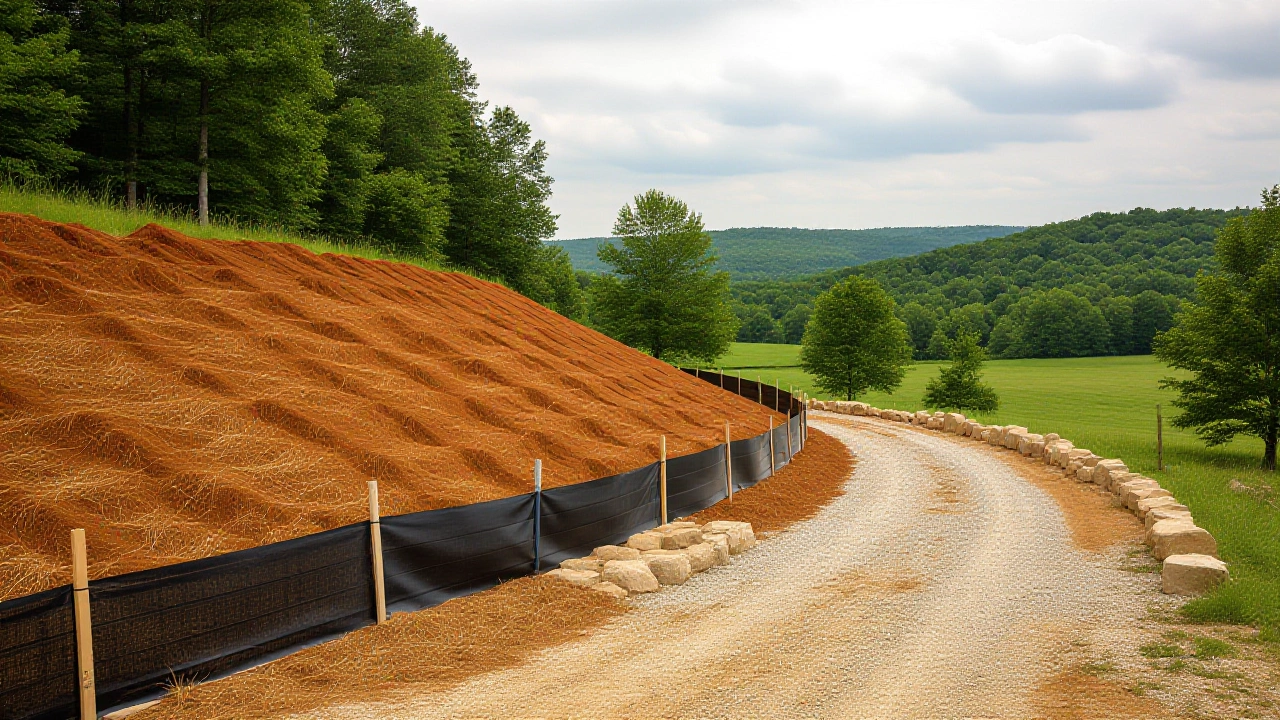
This work has two halves. Erosion prevention keeps soil from coming loose in the first place: grass seed, straw mulch, erosion control blankets on steeper ground, and leaving existing vegetation alone wherever the job doesn’t need it gone. Sediment control catches the soil that comes loose anyway, before it leaves the site: silt fence, check dams in ditches, protection around storm drain inlets, and a stone pad at the site exit so trucks don’t carry mud onto the road.
Prevention does most of the work. Sediment controls are the backstop, and backstops fill up.
Silt fence only works if it’s installed right
A silt fence is a strip of fabric on stakes that slows muddy water and lets the soil drop out before the water passes through. To work, its bottom edge has to be buried in a trench, not laid on the ground, or the water simply runs under it. It goes across the slope along the contour, with the stakes on the downhill side and the ends turned uphill so water can’t run around them.
It also needs emptying. On sites under the state permit, sediment has to be cleaned out of silt fences, traps and basins once their capacity is cut in half.
The clock in the state construction permit
For sites covered by TDEC’s Construction General Permit, timing is written into the rules. Erosion and sediment controls have to be in place and working before earth moving starts. Once work stops in a part of the site, temporary or permanent stabilization there has to be finished within two weeks. Steep slopes, defined as 35 percent grade or more, get one week.
The site is inspected at least twice a week, with the inspections at least 72 hours apart. The permit also says unpacked gravel containing fines, or crusher run, doesn’t count as a non-eroding surface, so a gravel-covered pad isn’t automatically a stabilized one.
Slopes on a house lot
A raw bank behind a new house or along a driveway cut is where homeowners see erosion first: gullies after a storm, mud on the patio. Seed and straw hold a gentle slope. Steeper ground gets seed under an erosion control blanket staked into the soil, so the grass can root before the rain finds it. A slope that keeps slipping even with cover is telling you it’s too steep for vegetation alone, and that’s where a retaining wall comes in.