
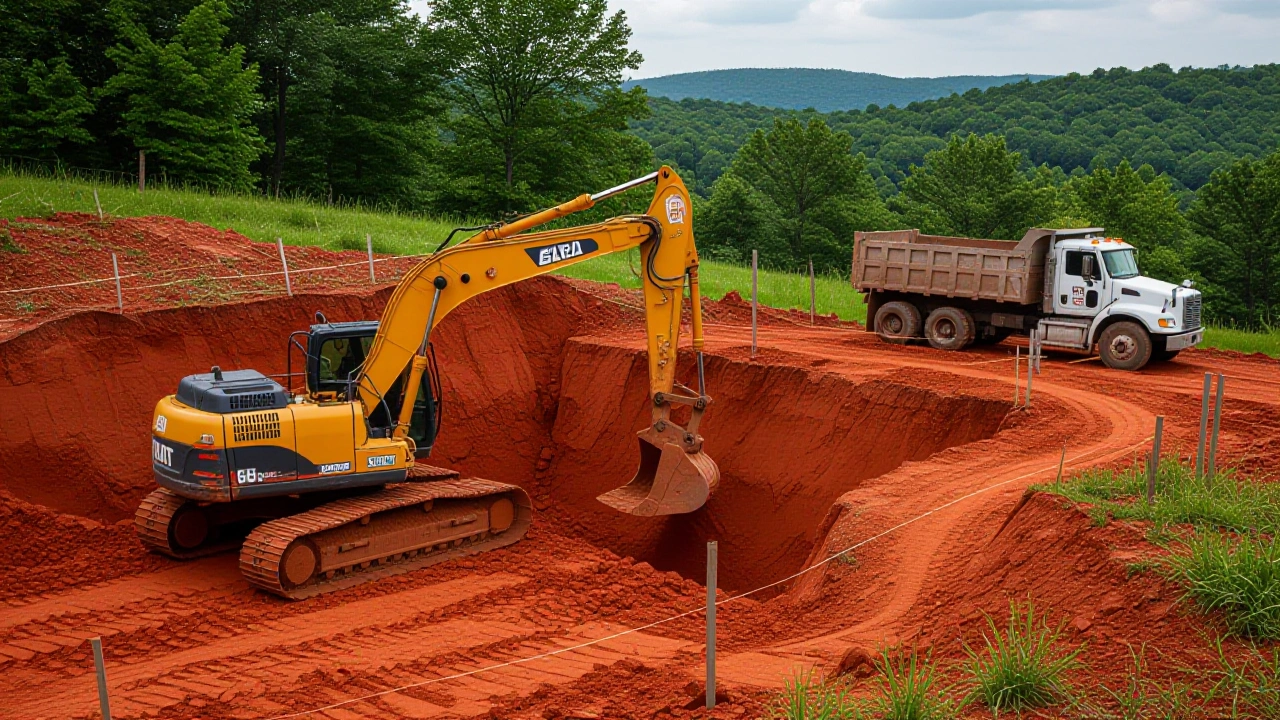
Dug to the plan, plus working room
Every dig starts with stakes. The plan sets the footprint and the bottom elevation, and the hole is cut a little wider than the walls so the foundation crew has room to set forms and waterproof. Footings go down to firm, undisturbed soil. If the bottom of the hole turns out soft, it gets dug out further and rebuilt with stone rather than poured over.
Ponds and detention basins are shaped differently. The side slopes and the outlet matter as much as the depth, and a dam or berm has to be built up in compacted layers from soil that will hold water.
The dirt has to go somewhere
Soil swells when it comes out of the ground; a basement’s worth of clay takes up a lot more room loose in a pile than it did in place. Some of it goes back as backfill around the walls. The rest is spread on the property, used to build up a low yard, or loaded and hauled. Deciding that before the dig starts keeps the lot from turning into a mud pile.
Rock: how far down it starts
Bedrock can sit close to the surface around Nashville. A USGS study of Middle Tennessee put the median depth to bedrock at 2.4 meters, about 8 feet, in the inner Central Basin and 3.7 meters, about 12 feet, in the outer basin, against roughly 15 meters on the Highland Rim. Those are regional medians, not a reading for your lot. A basement dig can hit ledge rock a few feet down or never touch it, and rock changes both the method and the price.
Water in the hole
Groundwater and rain both end up at the bottom of an excavation. A sump in one corner and a pump keep a footing trench workable after a storm, and a basement on a wet site often gets a perimeter drain before the walls go up. The sides of a cut also lose strength when they’re wet, which is why a deep hole gets its walls sloped back or braced instead of left standing straight.
Three working days’ notice to Tennessee 811
Tennessee 811 says anyone who digs, homeowners included, must give at least three working days’ notice before starting so the member utilities can mark their lines. A ticket is good for 15 calendar days after the start date it requests, and a dig that runs longer needs an update requested three working days before the ticket runs out. Basement jobs can outlast one ticket, so the renewal goes on the calendar at the start.