
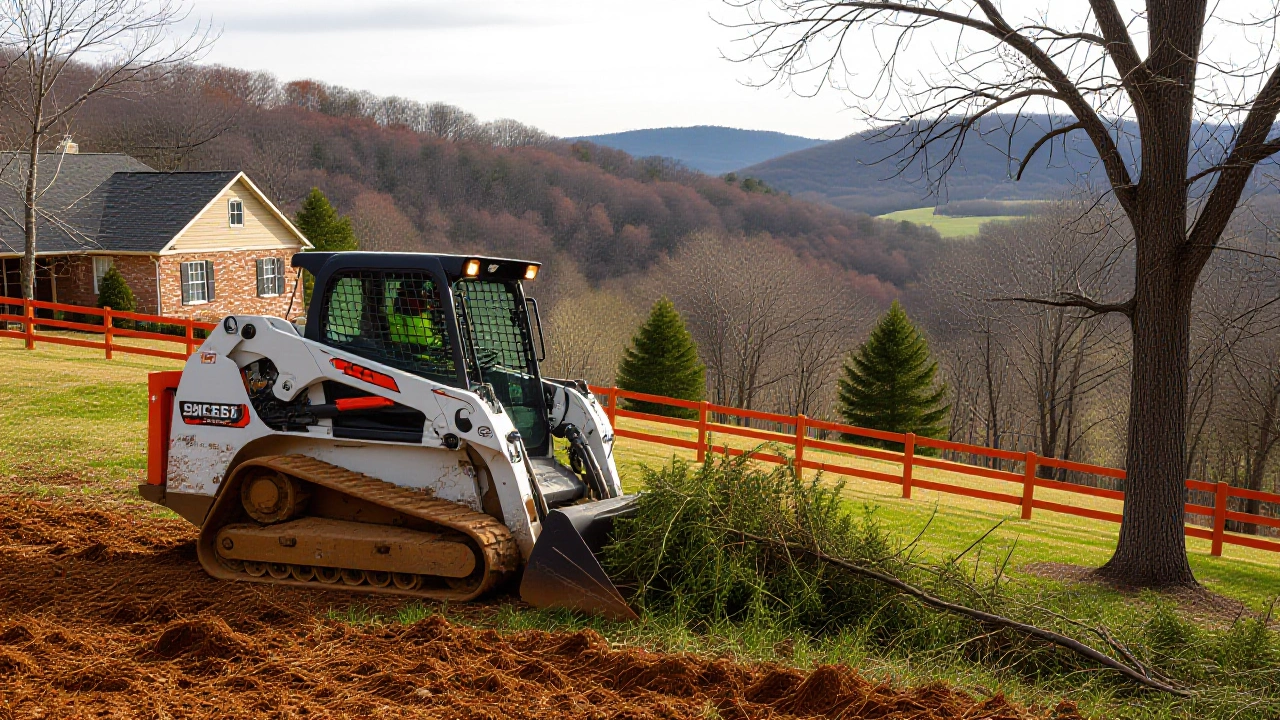
Site clearing or land clearing?
Here’s how we explain the difference: “land clearing typically involves preparing raw land including stumps and roots, while site clearing focuses on getting a specific project area ready.” A wooded tract headed for pasture is land clearing. A lived-on lot that needs room for a pool, an addition, a detached garage or a new driveway is site clearing.
The second job is usually the harder one to do well. There’s a house close by, a fence on the line, a septic field somewhere under the grass and an oak you’d like to keep. The machines have to work around all of it.
We mark what stays before anything is cut
On a site job our part includes “protecting the surrounding property and existing structures” while the project area gets opened up. That starts before a saw runs: a walk around the footprint with you, flagging the trees that stay, finding the fence line, the septic tank and field lines, the irrigation heads, and a path a truck can take without crossing them.
A tree you keep needs more than its trunk left alone. Most of its roots sit in the top foot or two of soil and spread past the edge of the canopy, so a machine parked under it or a pile of fill on its roots can kill it a year or two later. Where a keeper is close to the work, the ground under its canopy gets fenced off and traffic and stockpiles stay out.
On a development plan, the big trees get counted
Metro Nashville’s tree ordinance, BL2018-1416, took effect in September 2019. Among other things it requires heritage trees, those measuring 24 inches or more, to be surveyed on final site plans. If your project goes through site plan review, the trees you clear and the trees you keep are part of the paperwork before they’re part of the job.
On sites covered by the state construction stormwater permit, TDEC asks for the same restraint from another direction. Clearing and grubbing are held to what grading and equipment actually need, existing vegetation is kept where practicable, and the areas that stay undisturbed are marked on the ground.
What usually comes out
Stumps inside a building footprint come out with their roots. Stumps in a yard area that will only be seeded can be ground instead, which means less digging near the trees you kept.
- Overgrown brush, briars and vines
- Unwanted trees inside the footprint
- Saplings and volunteer growth along fence lines
- Old debris piles and junk that collected on the spot