
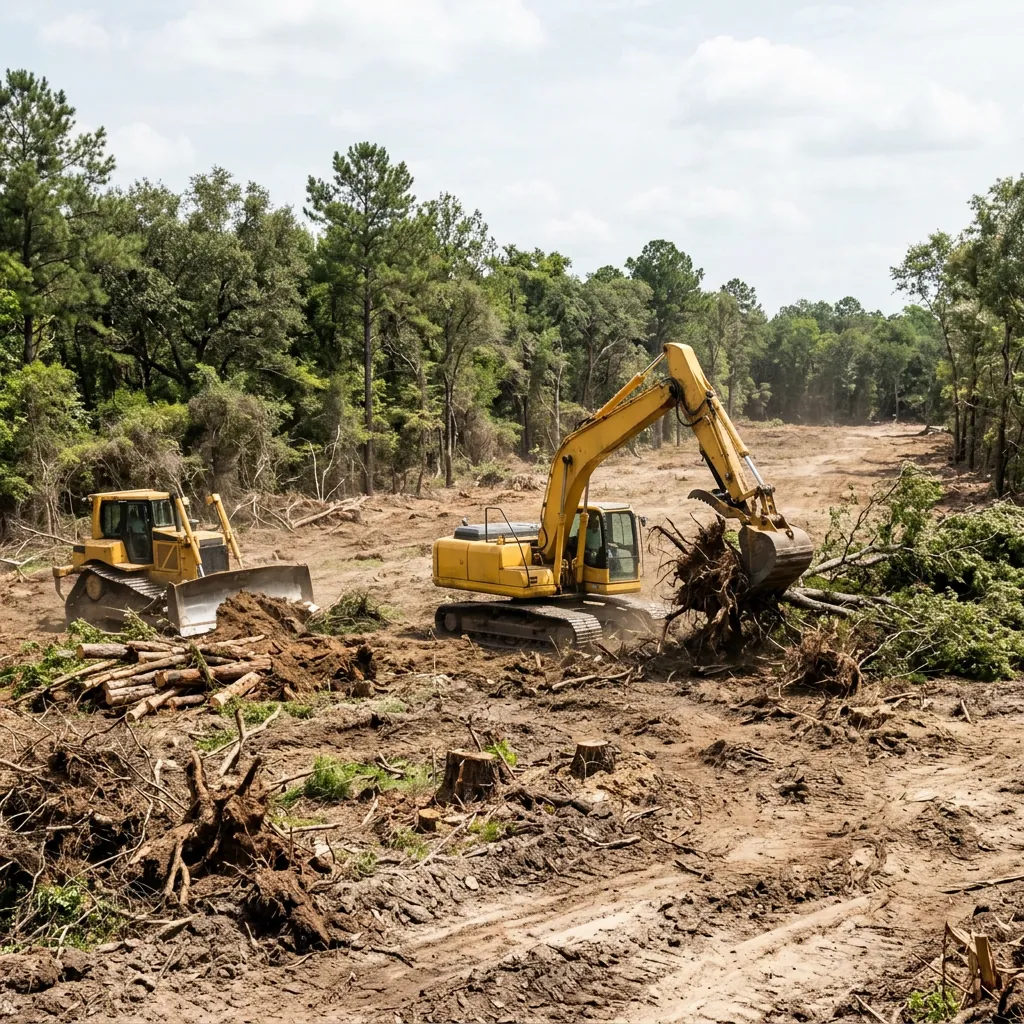
What comes off the ground, and in what order
Trees come down first, felled away from anything you’re keeping and cut into lengths a machine can handle. Brush, vines and saplings go next. Then comes the slow part, the stumps. A stump cut flush or ground a few inches down still leaves its root ball in the soil, and those roots rot over the years and leave soft pockets. That’s fine under a pasture. Under a driveway, a pad or a footing it’s a problem, so on ground that will be built on, the stumps and root balls come out whole.
Under the trees there’s usually a mat of leaves, small roots and dark topsoil. It grows grass well and holds a building up badly. Whether it gets stripped and stockpiled, spread somewhere else on the property or hauled off depends on what the land is for next.
- Standing trees felled and cut to length
- Brush, vines and saplings cut out
- Stumps and root balls pulled where you’ll build
- Root mat stripped and set aside when the plan calls for it
The wood: haul it, pile it or grind it
Every clearing job reaches the same fork. The trunks, limbs and brush can be loaded on trucks and hauled away, pushed into piles at a spot you pick, or ground up and left on the ground. Hauling means truck trips and dump fees. Piles mean giving up a corner of the property. Grinding leaves the material on site as cover, which suits a woodlot or a trail and doesn’t suit a house pad.
There’s no right answer for everyone. Someone opening up a hayfield and someone selling building lots usually pick differently. Tell us which way you want it and that’s how we’ll price it.
One acre: where the state construction permit starts
TDEC’s Construction General Permit covers clearing, grading, grubbing, filling and excavation that disturb one acre or more. Land under an acre can still need coverage when it’s part of a larger common plan of development or sale that adds up to an acre, and the permit asks for the application at least 30 days before work starts.
The permit also says existing ground cover shouldn’t be torn up more than 14 days before grading begins unless that area is stabilized in the meantime. So on a permitted tract, the clearing gets timed to the grading. Opening a whole tract in the fall and leaving it bare until spring is exactly what that rule is written against.
What to have ready when we walk the property
The acreage and where the property lines run. What the land is for next: a house, a barn, pasture, a sale. Any trees you want left, flagged if you can. How a loaded truck gets in and out. Those four answers decide most of the price, and they keep the walk-through short.