
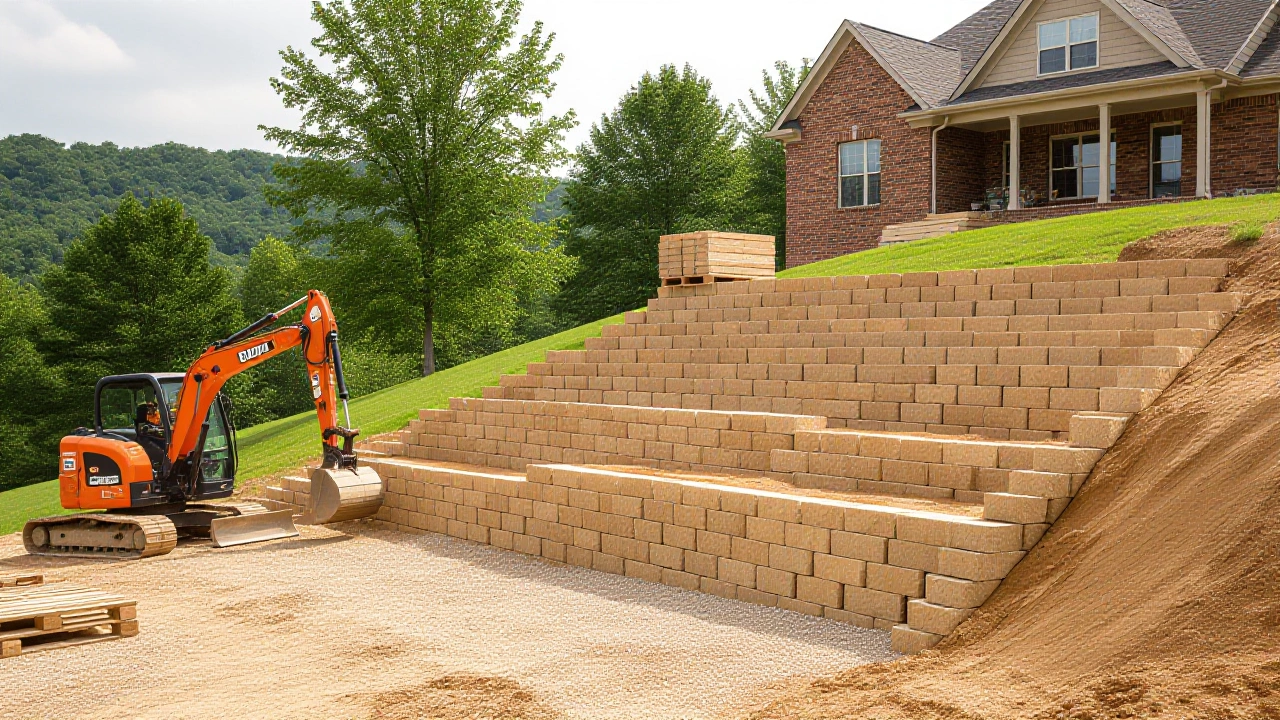
Regrade, drain or build a wall
A wall isn’t always the answer. If the slope is gentle enough to mow, grading it smooth and getting grass on it may be all it needs. If the trouble is water running down the bank, a swale or a drain at the top fixes the cause. A wall makes sense when there isn’t room to lay the slope back: the yard would lose too much flat ground, the driveway would get too steep, or the bank is already sliding.
Most of the wall is out of sight
What you see is a face of block or stone. What keeps it standing is underground and behind it. The trench is dug to firm soil and filled with compacted crushed stone for a level base. The first course sits partly below grade, and each course above steps back slightly into the hill.
Behind the wall goes a zone of clean drainage stone, with a perforated pipe at the bottom that carries water out the ends or through the face. Water is what pushes walls over. Clay holding rainwater gets heavy, and a wall with no way to drain it is fighting the full weight. Taller walls also get layers of geogrid, a reinforcing mesh laid back into compacted fill that ties the soil behind the wall to the wall itself.
- Excavation to firm subgrade
- Compacted stone base
- First course buried
- Drainage stone and perforated pipe behind
- Geogrid in compacted fill on taller walls
Grade changes and Metro’s 18-inch line
Building a wall almost always means cutting into the slope or filling behind it. In Davidson County, Metro Water Services’ grading permit exemption for maintenance and landscaping work holds only when the grade changes 18 inches or less. A wall that terraces a yard by several feet goes past that, so the permit question gets looked at along with the wall’s layout.
What changes the design
Height is the obvious one. Just as important is what sits above the wall. A lawn is one load, a driveway with parked trucks is another, and a house foundation near the top is another again. The soil, the slope above, and the room behind the wall for drainage stone and grid all go into the design before a block is set.